
Wasatch County Release Records
A Wasatch County release means one custodian ended its control of a person. It does not always mean the person walked into the community. The Wasatch County Jail may release someone on bond, after a court order, when a short sentence ends, or after a case is dismissed. It may also transfer someone to another jail, the Utah Department of Corrections, the United States Marshals Service, or immigration authorities. That transfer ends Wasatch County custody while another agency keeps the person confined. The release transaction and destination are therefore more useful than a missing roster name.
Wasatch County does not publish an official person-level jail roster or historical release archive on the Sheriff pages reviewed for this project. Once a person is no longer shown in a current system, use the jail, Utah VINE, the court docket, and a targeted Government Records Access and Management Act request. State prisoners follow a different route. The Utah Department of Corrections Offender Search covers people currently imprisoned by UDC or supervised by Adult Probation and Parole. A fully discharged person may no longer appear there.
Wasatch County Release Types
Release wording must be read with the case and custodian. Bond and own-recognizance release are forms of conditional pretrial release, not an acquittal. Time served links the exit to the jail term or credit recognized by the court. Probation is a court sentence served in the community and may begin without a prison stay. Parole is conditional release from imprisonment under a Board decision. Discharge or termination ends the sentence or supervision at a later point. Each term sends the search to a different record.
| Release type | Meaning | Next record |
|---|---|---|
| Bond or pretrial release | Custody ends while the case continues under set terms. | Jail transaction and court docket |
| Time served | The court-recognized county term or credit is complete. | Judgment, commitment, and jail timestamp |
| Probation | The court places the person under community supervision. | Court order and UDC supervision result |
| Parole | The Board authorizes conditional release from state prison. | Board decision, UDC result, and VINE |
| Transfer | Wasatch custody ends but another agency takes custody. | Receiving agency locator |
| Dismissal or court order | A judge removes the legal basis for this custody, subject to other holds. | Signed order and jail transaction |
A hold can complicate any row. One charge may be dismissed while another case, warrant, detainer, or sentence keeps the person confined. Ask the jail whether the event was a community release or a transfer, and identify the receiving agency when applicable.
Inside Wasatch County Release Records
Utah does not use one standard document called a release record. The Sheriff may hold a booking record with a release transaction, a jail-system printout, an authorization, a bond receipt, or a transfer entry. The court may hold the signed order, minutes, dismissal, judgment, sentence, or probation order. UDC and the Board split state information among an offender result, movement data, a written decision, and a supervision record. A narrow request should name the transaction and fields instead of asking for an entire file.
| Field | What it establishes |
|---|---|
| Full name and identifier | Connects the event to the correct person and booking. |
| Booking or offender number | Links jail, court, UDC, or Board records. |
| Release date and time | Shows when the named custodian physically ended custody. |
| Release type or authority | States bond, order, time served, parole, transfer, or another basis. |
| Releasing facility | Identifies which agency supplied the transaction. |
| Destination or receiving custodian | Separates community release from a transfer. |
| Hold or detainer disposition | Shows whether another restraint remained. |
The physical time and legal time may differ. A court can authorize release before jail staff finish identity, hold, property, and paperwork checks. A future Board date may still depend on conditions or later action. Preserve each label and timestamp rather than changing them into one guessed release time.
Request Wasatch County Release Records
The Sheriff FAQ directs requesters to complete a GRAMA form and submit it by mail, fax, or email. The public page says necessary fees apply but does not publish a flat price for a release record or booking photo. Utah law permits reasonable actual-cost fees and allows lawful redaction. Asking for electronic delivery and a cost estimate keeps the request focused.
- Identify the person with a full name and enough detail to avoid a namesake, such as a booking number or date of birth.
- Give a narrow booking or event date range and ask for the existing booking and release transaction.
- List the fields needed: booking number, release date and time, type or authority, and transfer destination if public.
- Ask the officer to provide all separable public portions and cite the classification for withheld material.
- Request an estimate before costs exceed a limit you choose, then keep the response with the matching court order.
1361 South Highway 40
Heber City, UT 84032
Jail: 435-657-1619
Records: wcsorecords@wasatch.utah.gov
Fax: 435-657-3580
Older records may remain requestable even though no historical web page exists. Web display and agency retention are different questions. Sealed, juvenile, expunged, private, controlled, or protected content may be absent or redacted. If age matters, ask the records officer which retention schedule applies. Court copies should come through the court's access process, not the Sheriff's form.
Note: The Sheriff does not publish dedicated records-counter hours, so call before an in-person visit.
Wasatch County Release Record Law
Utah's Government Records Access and Management Act, known as GRAMA, classifies records instead of declaring every government file open. Public portions may be separated from private, controlled, protected, juvenile, medical, personal, victim, or security material. Sections 63G-2-203 and 204 address fees and request handling. An agency response should identify the basis for withholding and the law supplies an appeal path.
Utah Courts' expungement process and Title 77, Chapter 40a can remove qualifying records from ordinary public access after an order. A missing case does not prove expungement. Spelling, court choice, access tier, system delay, and sealing can cause the same result. Ask the clerk or use the subject's own lawful access channel instead of guessing.
Wasatch Release Request Details
A useful GRAMA request names an existing record. For one person, ask for the public parts of the booking and release transaction tied to a specific booking date. Include the full name, booking number when known, and only enough date-of-birth information to resolve identity. Request the booking and release times, release type or authority, and the destination or receiving custodian if the event was a transfer. A separate line may request the booking photograph. This wording lets the records officer locate discrete fields without searching an undefined narrative file.
For a group of Wasatch County released inmates, give exact start and end timestamps in local time and ask whether the jail system maintains an existing release report or export for that period. GRAMA does not require the Sheriff to create a new report or analysis. Ask for electronic delivery and a fee estimate before a limit you set. The Sheriff publishes no flat release-record fee, so a page cannot promise a price. Utah Code permits actual-cost fees subject to statutory limits and possible waiver rules.
Ordinary GRAMA requests generally receive a response within the statutory track described in Section 63G-2-204, while a qualifying expedited request follows a shorter track. A response is not the same as immediate production of every requested field. The agency may disclose, deny, seek clarification, provide an estimate, or separate public information from restricted material. If a field is withheld, keep the classification and cited basis with the records that were supplied.
Wasatch Jail's Mixed Custody
The Sheriff's Corrections Division describes a 100-bed jail intended for people serving less than one year, with about 40 corrections deputies. It also houses some people for the state prison system under contract. Two people in the same building may therefore have different legal custodians and release authorities. One may leave on a local bond. Another may remain in UDC custody and later move to a prison or be processed for parole through state channels.
Ask one direct question before choosing a locator: was the person held for Wasatch County, another agency, or UDC? For a local community release, request the Sheriff timestamp and disposition. For a UDC-sentenced person, check UDC, the Board, and VINE. This mixed population is why the building name alone cannot settle release status.
Find Released Wasatch County Inmates
Start with the custody that may have ended. The jail is the best first contact for a local booking or short county sentence. Utah VINE can add a near-current event. The court explains why custody should end. UDC and the Board control the state-prison path, while BOP and ICE cover distinct federal systems. A strong result joins the physical custodian's transaction to the legal authority.
- Call the Wasatch County Jail and ask whether the person is in custody now. If not, ask whether the event was community release or transfer.
- Search Utah VINE by name or identifier. Record the reporting agency, exact status wording, event time, and date checked.
- Use Utah Courts Xchange or the person's MyCase account to find the signed bail, release, dismissal, judgment, sentence, probation, or commitment entry.
- For a state sentence or current AP&P supervision, search UDC and the Board by UDC number when available.
- For federal or immigration custody, continue through BOP or ICE and the matching court docket.
- If the event remains unclear, request the release transaction and receiving custodian from the correct agency.
Write down identity, agency, event, time, and authority. Identity distinguishes namesakes. Agency identifies the source. Event preserves the exact word, such as released, transferred, paroled, or terminated. Time records both the event and lookup time. Authority is the order, sentence, Board decision, bond process, or commitment. This five-part check exposes false matches.
Reconcile Wasatch Release Results
Different timestamps do not always conflict. A judge may sign an order, a clerk may enter it later, jail staff may complete hold and property checks after that, and VINE may receive the event on another schedule. Preserve each source's time and label. The signed authority explains why custody could end. The physical custodian establishes when the person moved. One should not be silently substituted for the other.
Suppose VINE reports that Wasatch County released a person, but the Sheriff transaction names UDC as the receiving agency. That is a transfer despite the county-side release wording. If the court dismisses one charge while the jail identifies another hold, the dismissal does not establish full release. If the Board sets a future Tuesday date while UDC still shows prison housing, the decision remains prospective. A community location and case manager after that date can support a prison-to-parole move, but it does not show discharge from supervision.
When two official records remain inconsistent, contact the office responsible for each source record. Keep the request, response, docket entry, event wording, and date checked. Until the custodian and authority align, use “not confirmed” instead of declaring that the person is released or still confined. That phrase reflects the limited evidence without turning a blank search into a fact.
UDC Search for Wasatch Releases
The UDC tool accepts first and last name with an optional middle name, or a UDC offender number. It covers only people currently incarcerated by UDC or on UDC probation or parole. It excludes unsentenced county-jail detainees and is not a permanent discharge archive. A community location and case manager may show that a person left prison but remains supervised.
| Search or result field | How to use it |
|---|---|
| First and last name | Both need at least one letter; compare date of birth before opening a match. |
| UDC offender number | Best way to avoid a namesake and reach the matching record. |
| Location and housing facility | Read together to distinguish prison housing from community supervision. |
| Release Date/Type | Preserve this combined official label and compare it with the Board decision. |
| Case manager and email | Provides a direct AP&P verification path for current supervision. |
The official UDC search screen shows the scope and fields used for Wasatch-origin state cases.
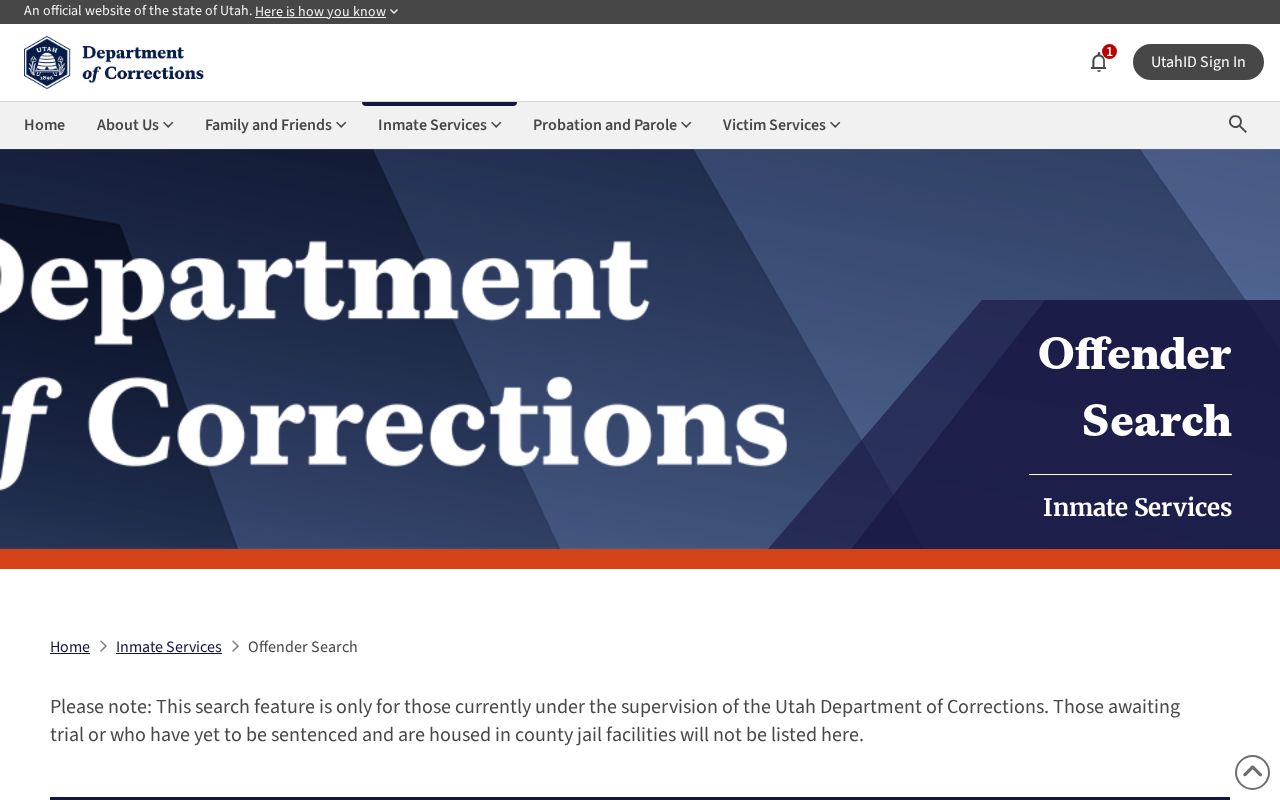
The screen should be read with a Board decision and direct agency confirmation because a future date does not prove a completed release.
Wasatch County Recent Releases
No official 24-hour, 72-hour, released tab, archive, or Sheriff mobile inmate app was found on the reviewed official pages. The time window is therefore a request range, not a county web feature. Call the jail, check VINE, match the court docket, and ask whether the jail system maintains an existing release report for the exact start and end time. GRAMA does not require an office to create a new analysis it does not keep.
VINE is event-based, not a complete chronological county release log. Court entries explain the legal cause but may not show the physical processing minute. Jail, court, VINE, and UDC systems update on different schedules. When timing matters, direct jail confirmation remains necessary. A 24-hour release request should use an exact, date-bounded range.
Note: County-like commercial domains are not official Wasatch Sheriff sources and cannot establish a release feed's fields or timing.
Wasatch Post-Release Supervision
The Utah Board of Pardons and Parole makes parole and sentence-termination decisions. UDC Adult Probation and Parole supervises people in the community. Probation comes from a court order. Parole follows imprisonment under Board conditions. Discharge or termination is a later end to supervision and sentence. These terms are not interchangeable.
Start with the UDC offender result and read Release Date/Type, location, housing facility, case manager, and email together. Then search the Board's Hearings and Decisions tool for the ordered date and later action. The Wasatch County Community Resource Guide identifies Region IV as the local AP&P layer, but current UDC navigation should control because assignments can change.
Wasatch State Release Day
UDC publishes a specific schedule that does not apply to ordinary Wasatch County bond-outs. State releases and paroles are processed on Tuesdays, and almost all occur at Utah State Correctional Facility. UDC says direct release of a state prisoner from a county jail is extremely rare. A person housed at the Wasatch jail for UDC may therefore be moved to Salt Lake City for state release processing instead of walking out through the county release path.
The release-day rule belongs to UDC legal custody. A person bonding out of the Wasatch County Jail, completing a short county term, or leaving after a local court order is not placed on that statewide Tuesday schedule. Confirm whether the jail held the person for the county or for UDC before applying the state process. The mixed population inside the Wasatch jail makes that question necessary.
Getting Home After Wasatch Release
The UDC Release Day instructions also say a person without a ride may be taken by a release-team member or volunteer to a nearby UTA TRAX station and may be released later in the day's sequence. That is not a promise of transport from Wasatch County Jail. Confirm the actual release point and case instructions before anyone travels.
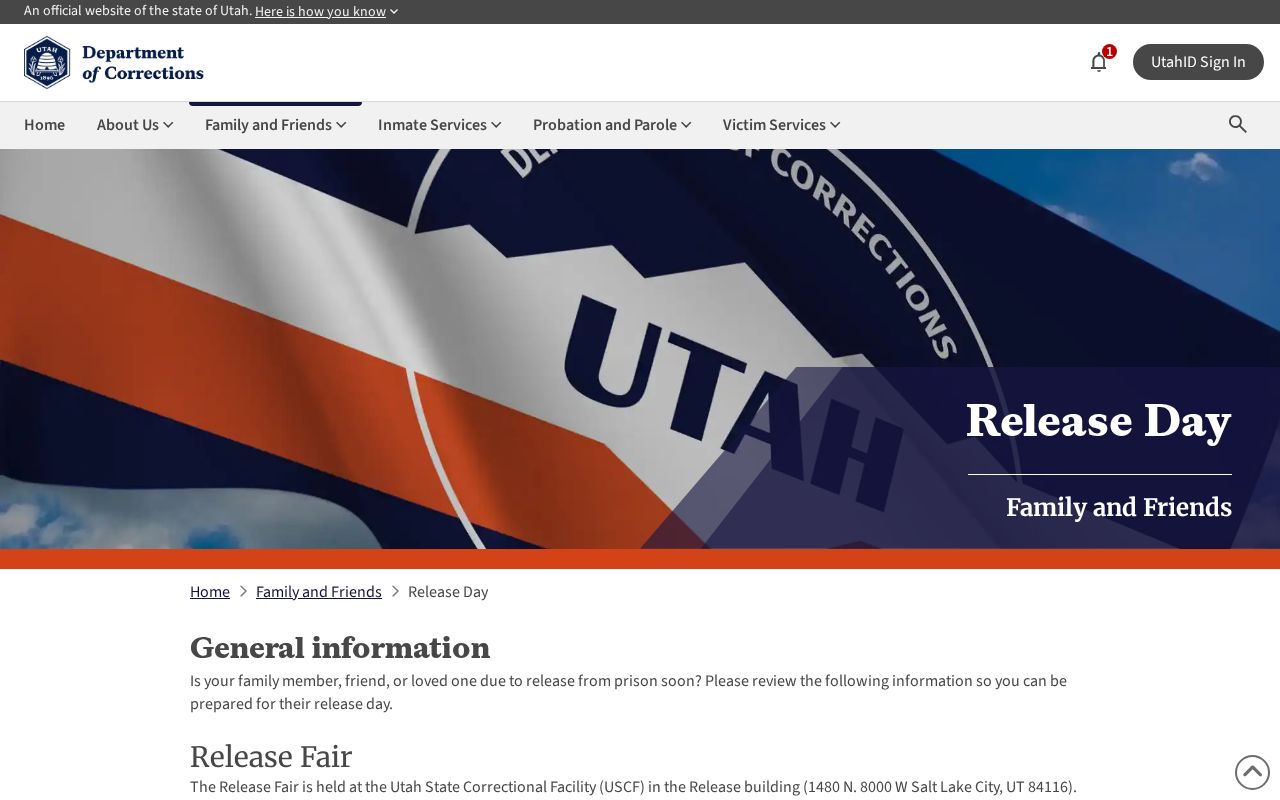
The release-day material helps separate county custody from a state-prison release and prevents a Tuesday rule from being applied to local jail events. A Wasatch-origin state prisoner may be processed in Salt Lake City rather than at the prison or county jail where the person was housed. Families should wait for person-specific instructions before arranging pickup or transit.
Property After Wasatch Release
Property pickup also depends on the custodian. UDC maintains an official state property channel. The Wasatch Sheriff FAQ discusses property and commissary while a person is confined but does not publish a post-release pickup procedure. For a county release, call the jail and ask where and when stored property can be collected, what identification is required, and how an error is reported.
Do not apply the state process to county property. The same rule works in reverse. A bag held by the county and an item held by UDC belong to separate systems even when the same person moved between them.
Wasatch Release Orders and Courts
The Sheriff provides security and bailiff services for courts at the Justice Center campus, but that shared place does not merge the records. The Sheriff owns the jail release transaction. The court owns signed orders and dispositions. Wasatch cases may be in the Fourth District Court or the Wasatch County Justice Court, depending on the filing and offense level. Juvenile access is restricted.
Utah Courts Xchange is the statewide public search path for district and justice cases. MyCase is better for a party viewing that party's own eligible matter. Look for bail terms, release orders, dismissals, jail credit, judgments, commitments, probation orders, warrants, and later satisfaction entries. The signed order explains why custody should change; the jail record shows when Wasatch physically acted.
Wasatch Court Release Records
Begin with the court named on the charging document or case number. Wasatch County is part of Utah's Fourth Judicial District, but not every booking belongs in district court. The Wasatch County Justice Court handles matters within its local jurisdiction. One jail booking can also connect to more than one case or hold. Searching only one court may therefore explain one release condition while missing the legal basis that kept custody in place.
Read the docket in date order around the claimed release. An initial appearance may set bail or pretrial terms. A later signed order can reduce bail or direct release. A dismissal ends that charge but may leave another case or detainer. A judgment can show a jail term, credit for time served, probation, or commitment to UDC. The event label “case disposed” does not mean the same thing as “sentence complete.” A case may be disposed while probation, restitution, supervision, or another court obligation continues.
The court and jail answer separate questions. A judge's order establishes legal authority, while the Wasatch County Jail transaction records the physical exit or transfer. If the court entry appears first, allow for jail processing and other holds. If the jail reports a transfer, follow the receiving custodian even when the local case shows a completed sentence. Matching the case number, booking number, person identifiers, and dates prevents an order for one matter from being applied to another booking.
Access limits also explain missing results. Juvenile matters, sealed records, expunged cases, and other nonpublic documents may not appear in ordinary public search. MyCase can provide a party with access to that party's eligible matter, while a clerk may supply copies allowed under court rules. Do not treat a blank Xchange result as proof of expungement or proof that no case exists. Confirm spelling, court, date range, and access level before drawing a conclusion.
Wasatch Release Alerts and Transfers
Utah VINE through VINELink searches one person by name or offender number and supports phone or email notice. Events include release, transfer, escape, return, death, an advance parole-date notice, and moves among state sites, county jails, and community correctional centers. Record the reporting agency and exact event wording. A release from one contributor may still be a transfer to another.
No dedicated federal or ICE detention facility was identified in Wasatch County. A Wasatch jail transaction can still end with handoff to USMS, BOP, or ICE. The BOP Inmate Locator covers sentenced federal people and may show a past release date or a status that BOP no longer holds the person. The ICE locator covers current immigration custody through A-number or biographical search. Neither result by itself proves community release or the end of all supervision.
Wasatch VINE Release Notifications
For a one-person VINE search, choose Utah, enter the name or offender number, compare the available identifiers, and open the result tied to the correct reporting agency. Save the custody status, event wording, and date. A released result means that contributor reported an end or change in its custody. It may not name the destination. Call the Wasatch jail for a county event, or compare UDC and Board records for a state event.
Registration begins from the matched person record. Select the available phone or email notice, enter the contact information, create the requested telephone PIN, and confirm the registration. UDC states that registration is anonymous and that multiple phone numbers may use the same PIN. Telephone calls repeat hourly for up to 48 hours until the correct PIN confirms receipt. A live operator can assist in English or Spanish through the Utah VINE line.
VINE alerts include release, transfer, escape, return from escape, death, an advance parole-release-date notice, and moves involving state sites, county jails, or community correctional centers. The scope depends on the contributing agency. Treat a transfer alert as continued custody and an advance date as prospective. UDC advises users not to depend on VINE alone, and the Board directs callers to verify status when technical issues affect notifications.
Where Wasatch Release Records Appear
Choose the source by legal custodian and record purpose. A current-custody lookup answers a different question from a historical release transaction. A transfer can appear as the end of one row and the start of another.
| Situation | Best source | Limit |
|---|---|---|
| Current Wasatch jail custody | Direct jail confirmation | No official public roster was found. |
| Past county release | Sheriff transaction plus court order | Requires phone disclosure or GRAMA request. |
| State prison or AP&P | UDC search plus Board decision | UDC covers only current supervision. |
| Near-current event | Utah VINE | Event-based and subject to reporting delay. |
| Federal sentence | BOP locator plus federal docket | BOP status does not resolve state or ICE custody. |
| Immigration custody | ICE locator and receiving-agency record | No result is not proof of release. |
Wasatch County Release Facilities
Wasatch County Jail handles local custody and some contracted UDC housing. Utah State Correctional Facility is the usual UDC release point, even for many people housed elsewhere. Central Utah Correctional Facility can house a Wasatch-origin state prisoner, though release processing usually occurs at USCF. The federal and immigration page explains transfers where no dedicated local facility was identified.
- Wasatch County Jail: confirm local release or receiving custodian with the Sheriff.
- Utah State Correctional Facility: use UDC, Board, and VINE records.
- Central Utah Correctional Facility: verify housing separately from the USCF release point.
- No dedicated federal or ICE detention facility identified in Wasatch County: continue with BOP, ICE, or the federal docket.